
CASE STUDY
OTIS 2.0 — Modernizing Citation Workflows for the Ohio State Highway Patrol.
Organization: Ohio State Highway Patrol
A State Organization in Ohio supporting all 800+ State Troopers
Position: Lead UX Design and Research
In charge of Product Design & Research
Summary
The Ohio State Highway Patrol is modernizing mission-critical software used daily by troopers and dispatch. Legacy workflows required heavy legal and jurisdictional data entry under stressful, mobile conditions, where intermittent connectivity and unsignaled refreshes risked data loss and eroded trust. We partnered with OSHP to conduct field research (including ride-alongs), map end-to-end workflows, and design a Fluent UI–aligned system with progressive data entry and robust autosave/restore.
Early prototypes focus on reducing cognitive load, standardizing patterns across modules, and preserving work at every meaningful event (e.g., adding a person/vehicle or scanning a driver’s license). The program lays the groundwork for safer, faster, more reliable reporting—without sacrificing compliance.
PROBLEM
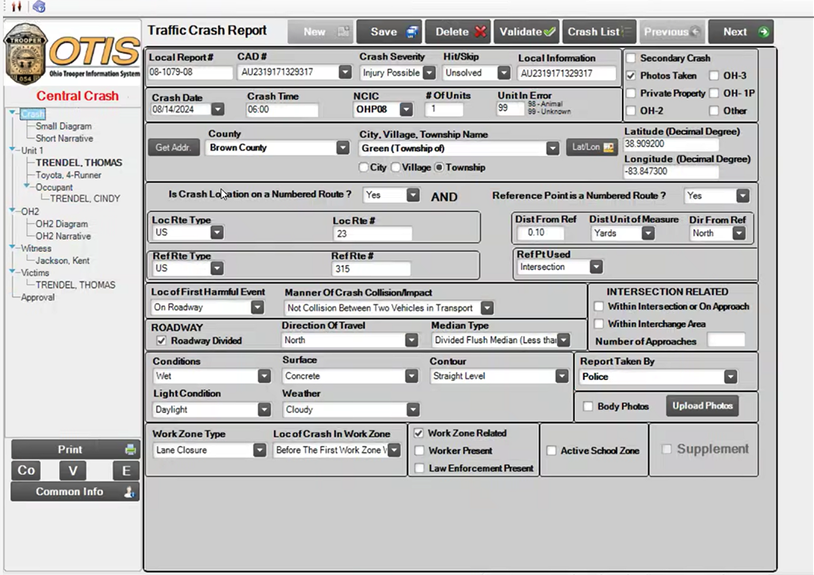
Legacy patrol and citation software forced troopers to complete long, compliance-heavy forms in roadside conditions with unreliable connectivity. Unsaved work could be lost on refresh or device hiccups, leading some users to draft in Word as a workaround. Inconsistent ASP.NET screens and patterns increased error risk, slowed training, and eroded trust in the system.
Heavy legal/jurisdictional data entry created high cognitive load and rework.
Intermittent connectivity and unexpected refreshes caused draft loss.
Fragmented UI patterns reduced confidence and slowed onboarding.
Duplicate entry (people/vehicles) and limited validation increased errors.
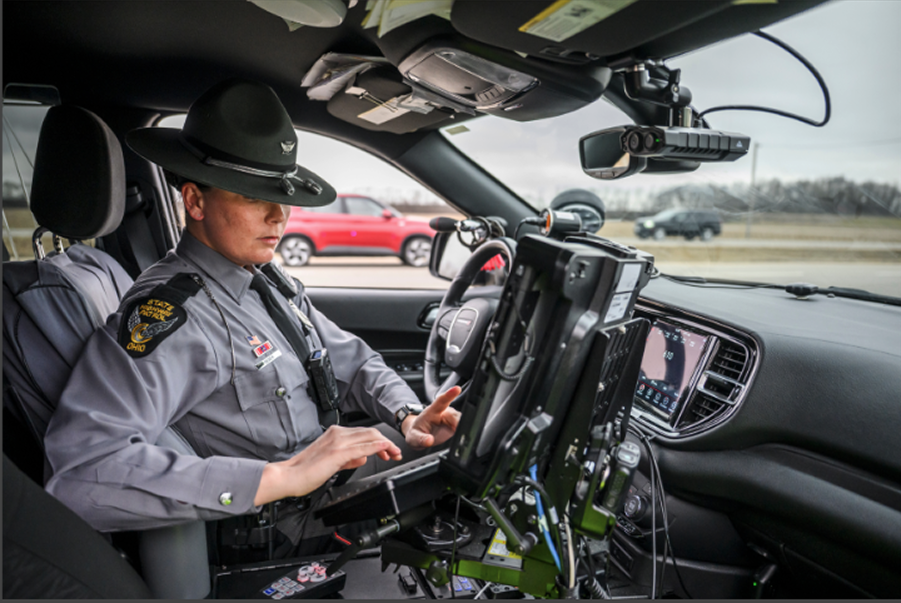
IMAGE: Aging critical emergency software.
PLANNING
We paired field research with a design-system-first rebuild to make the experience reliable, recoverable, and learnable. Ride-alongs, interviews, and task analyses informed workflows; Fluent UI patterns with governed tokens/variables in Figma ensured consistency; and a progressive data-entry model lowered cognitive burden while preparing for analytics-driven iteration.
Ethnographic observation (ride-alongs), contextual inquiry, interviews, and journey mapping.
Fluent UI alignment with governed design tokens, variables in Figma, and component libraries.
Progressive data entry with clear status, inline validation, and error-recovery microcopy.
Instrumentation plan (time-to-complete, draft-loss, error hotspots) and offline-first strategy.
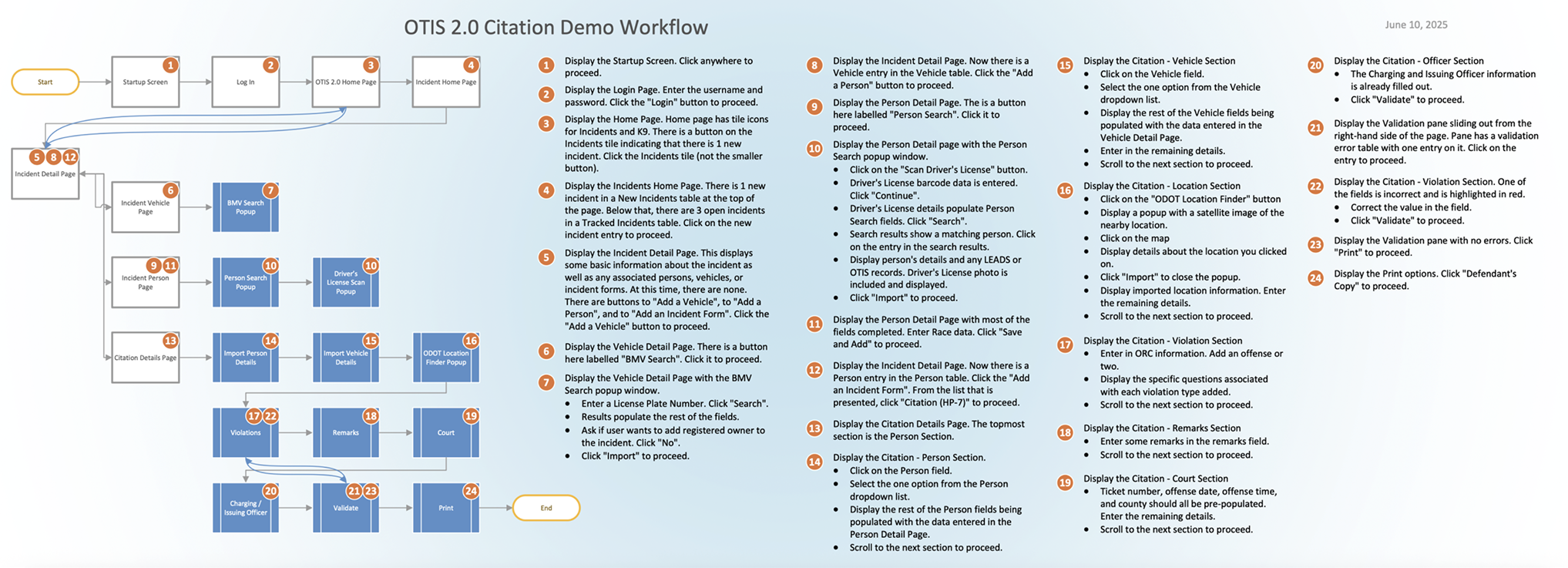
Strategic and timely demos were made to statewide leadership underneath the Governors purview for state safety, and UX testing to assure on boarding and trooper adoption. (Below: An example of a citation demonstration given to leadership.)
Trooper persona created
With thin resources, the state had never created persona specifically for Ohio State Highway patrol troopers, and their responsibilities, roles, and statewide impact. Specific personas were developed for unique types of responsibility between the state trooper division. These are too examples of those roles.
Ethnographic research was utilized in the observation and detailed documentation of the existing use cases of the software, paper document documents, and physical activities associated with utilizing the mobile devices currently in place.
Design changes and recommendation findings were compiled and discussed with leadership.
It was agreed-upon that a complete rebranding from the ground up, was necessary to not only take advantage of daytime and nighttime driving but also quick access to hotspots within the software during high speed engagements.
The utilization of larger, oversize buttons, the elimination of paper, documentation into digital documentation, and other critical emergency based findings were compiled and assessed by the leadership committee.

Design system, and design tokens
I created a formal design system in Figma and design tokens associated with every component for fast load time in the new architecture focused on fluent UI.
Offline draft cache with background sync and “Restore last draft,” preserving work through crashes/refreshes.
Standardized, tokenized patterns (review/submit, error states, forms) for consistency and quicker training.
Solution
We implemented event-based autosave/restore, an offline-friendly draft cache, and standardized patterns with smart defaults/prefill. Entities (people/vehicles) are reusable across citations, and visible save states rebuild confidence. Early signals show faster completion, fewer errors, and reduced reliance on third-party workarounds—setting a foundation for measurable gains in safety, compliance, and trust.
Event-based autosave triggers: add/import person, add/import vehicle, license scan, attachment upload, jurisdictional change, step completion, plus periodic idle saves.
Offline draft cache with background sync and “Restore last draft,” preserving work through crashes/refreshes.
Standardized, tokenized patterns (review/submit, error states, forms) for consistency and quicker training.
Early outcomes: decreased duplicate entry, improved trust, faster onboarding; next metrics tracked—time-to-first-citation, draft-loss rate, and form error rate.
>99.5% save reliability.
Previously, unexpected refreshes wiped work; event-based autosave + offline drafts now preserve every step and restore trust..
20–30% fewer form errors.
Progressive entry, smart defaults, and reusable people/vehicle entities streamline completion.
25–35% faster to first citation - pilot goal.
Progressive entry, smart defaults, and reusable people/vehicle entities streamline completion.
30% faster onboarding.
Standardized Fluent UI patterns with governed design tokens and Figma variables.
OUTCOMES
Early impact (qualitative)
Rebuilt trust. Clear save/restore feedback reduces anxiety and reliance on external workarounds.
Less duplicate entry. Reuse of previously captured entities (people/vehicles) lowers time-to-complete.
Faster onboarding. Consistent patterns and language improve learnability and reduce support needs.
What we’re measuring nextTime-to-first-citation (start → submit) in the field.
Draft-loss rate and recovery events post-autosave.
Form error rate (before/after progressive entry + validation).