

Modernizing a Multi-Phase UX Deployment for Order Management at Adaptive
Author: Michael Clingerman | Date: May 2024

Problem
Adaptive Biotechnologies faced significant challenges with its outdated Order Management System (OMS) and Laboratory Information Management System (LIMS), which caused inefficiencies in specimen tracking and patient data management. Non-intuitive workflows and limited data insights increased the cognitive load on analysts, hindering operational efficiency and decision-making. To support rapid growth, the company required a unified, scalable system with enhanced user experience and advanced analytics.
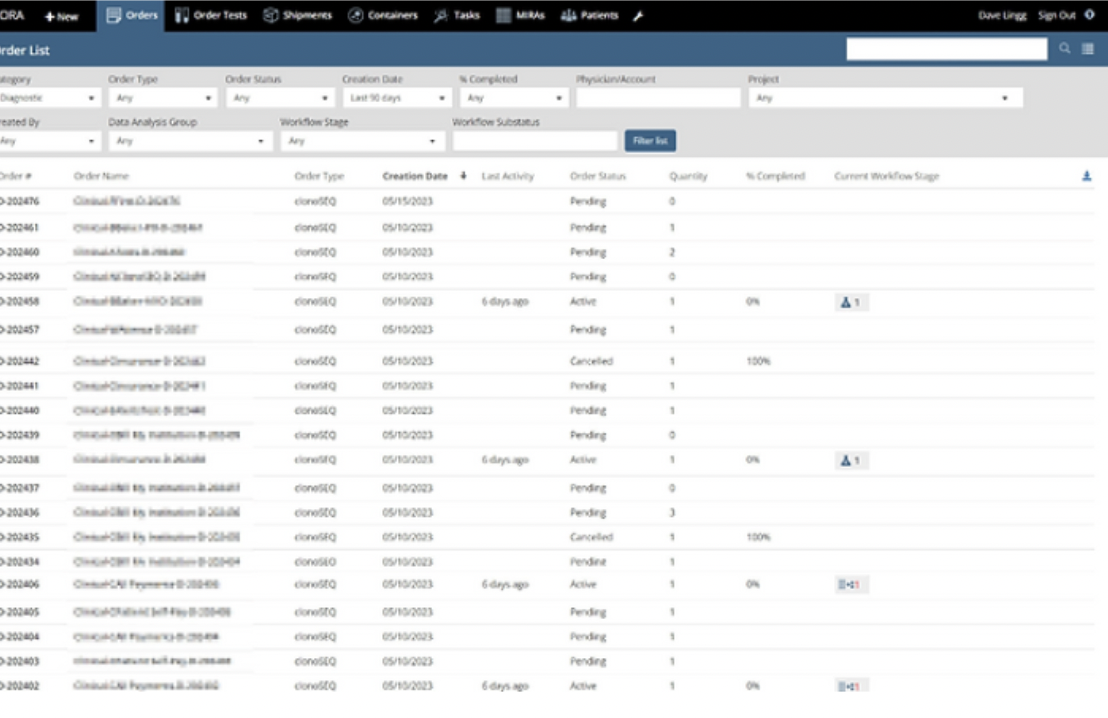
Image: The original system has many component libraries and no “official“ design system.
The UX team led a dual-track development process, initially replicating existing workflows to ensure business continuity while progressively introducing design improvements. Through early ethnographic research and SME-led audits, we identified critical pain points, such as cognitive overload, fragmented workflows, and navigation inefficiencies. The adoption of IBM’s Carbon Design System provided a scalable, modern design framework that improved navigation, data visualization, and workflow consistency across Adaptive’s platforms.
Approach

Research Findings
From our research, the UX team discovered the need for the following themes of user experience enhancement:
Quick Summary of UX Findings:
Cognitive load Reduction
Management of daily work
Simplification of navigation
Re-focusing patient architecture, lists, linking
Streamlining specimen and shipment workflows
Dashboarding analytics
-
Our persona interviews surfaced an important commonality: the users’ jobs were incredibly detailed and “in-the-weeds.” The interfaces of the old system were cluttered with numerous fields and excessive information, overwhelming users. Each time challenged their need to see all of those fields, they reiterated that the inclusion of all fields was necessary. We would need to find a way to reduce cognitive load without removing content.
-
Our research surfaced challenges around managing daily work:
Delegating work was not always cut-and-dry. Some of the teams interacting with the system were fairly large, and most often, multiple eyes were required on the same order, specimen, or patient. Resolution of issues required for phone calls, emails, notes, and cross-system usage. Users always needed multiple tabs open, to reference other systems.
Many of the issues needing resolution were complex in nature and often required multiple users with their own knowledge and background information.
Much of the time spent by users was focused on painstakingly tracking down orders or patients, like a bad treasure hunt. For example, users would be forced to use the slow and clunky filtering capabilities on the old system to open multiple tabs to see if they offered the right set of characteristics for the user to accomplish their tasks.
The highlight use-case for the order management system was that users needed to manage their daily work by looking for active orders that had similarly related problems. This approach helped them cognitively address the same “chunk” of problems within a period of time.
-
Navigation offered by the old system was intuitive, as though an afterthought.
Our UX team was able to learn a lot and seek guidance from Carbon’s thoughtful navigation guidelines. We later brought this thinking into a few simple, yet promising navigational improvements.
Re-focusing patient architecture, lists, linking
Adaptive aims to be a patient advocacy organization. There is immense business value in orienting the user experience around any opportunity to clarify patient information.
We discovered the following pain points for users viewing patient data:
Patient Details pages lacked real-time information about Orders and Specimens.
We discovered that this information lived at the heart of inquiries by our customers (Clinicians offering clinical care for the patients.) Ie. users had to search for a list of orders relevant to a patient open all those orders in separate tabs, and then cognitively distill an overview of the most recent issues, orders, and statuses.
Patients often showed up as duplicates in the system.
Due to easily made human errors of birthdate or name-change discrepancies, one patient might end up in a fragmented display of duplicate records. These were high-priority issues that our analysts had to address.
Information architecture was oriented around Orders, not Patients.
If a physician called in curious about the status of clinical care for one of their patients, there was no quick view in the old system to provide that information.
Clinical trials offering de-identified information had no way of linking to Patient information that was already in the system. This implication on the patient's end was painful: they would have to take multiple blood or bone marrow samples to provide the same information, over and over again. Knowing that the information was in the system but simply lacking the wiring to connect – this highlighted a high-priority concern.
-
Historically, the molecular biology laboratory at Adaptive, which handles specimens and samples for clinical diagnostics (Dx) and clinical trials research, has used varied terminology and labels across its systems. The data transfer between these systems is nuanced and complex. To streamline this, a significant reorganization effort was undertaken to simplify system labeling and clarify the parent-child relationships among specimens, samples, shipments, and orders. A key outcome of this effort is the introduction of "Flags," a feature designed as a catch-all indicator for any significant events affecting an order throughout its lifecycle. While "Flags" is detailed in a previous chapter, it also plays a crucial role across data tables, alerting users to any flagged orders, specimens, samples, or shipments that require attention due to alerts or discrepancies before they can proceed in the processing pipeline.
We discovered the following needs for an improved treatment of Specimens and Shipments:The users of the New LIMs Ecosystem at Adaptive require a unified approach to manage specimen samples and shipments across multiple software systems.
Within the order management software, it would be critical for Clinical Services to receive timely updates once specimens complete the intake process and are ready for the resolution of any flags that may arise during the shipment receiving or intake phases.
Users would require a centralized interface for updates and data, rather than being forced to navigate multiple siloed sources like Salesforce and Tableau. This fragmentation complicated workflows and hampers efficiency, highlighting the need for a more consolidated, integrated approach to data management and notification within the ecosystem.
-
The new Order Management System (OMS), used by various customer-facing teams was lacking the contextual tools necessary for understanding:
order statuses,
issues and
assignments.
Additionally, leadership faced challenges in gaining deep insights into critical metrics like:
Revenues,
sales, and
incoming orders.
Please read on to discover our recommendations for the findings we’ve described in this last section.
A New Design Process
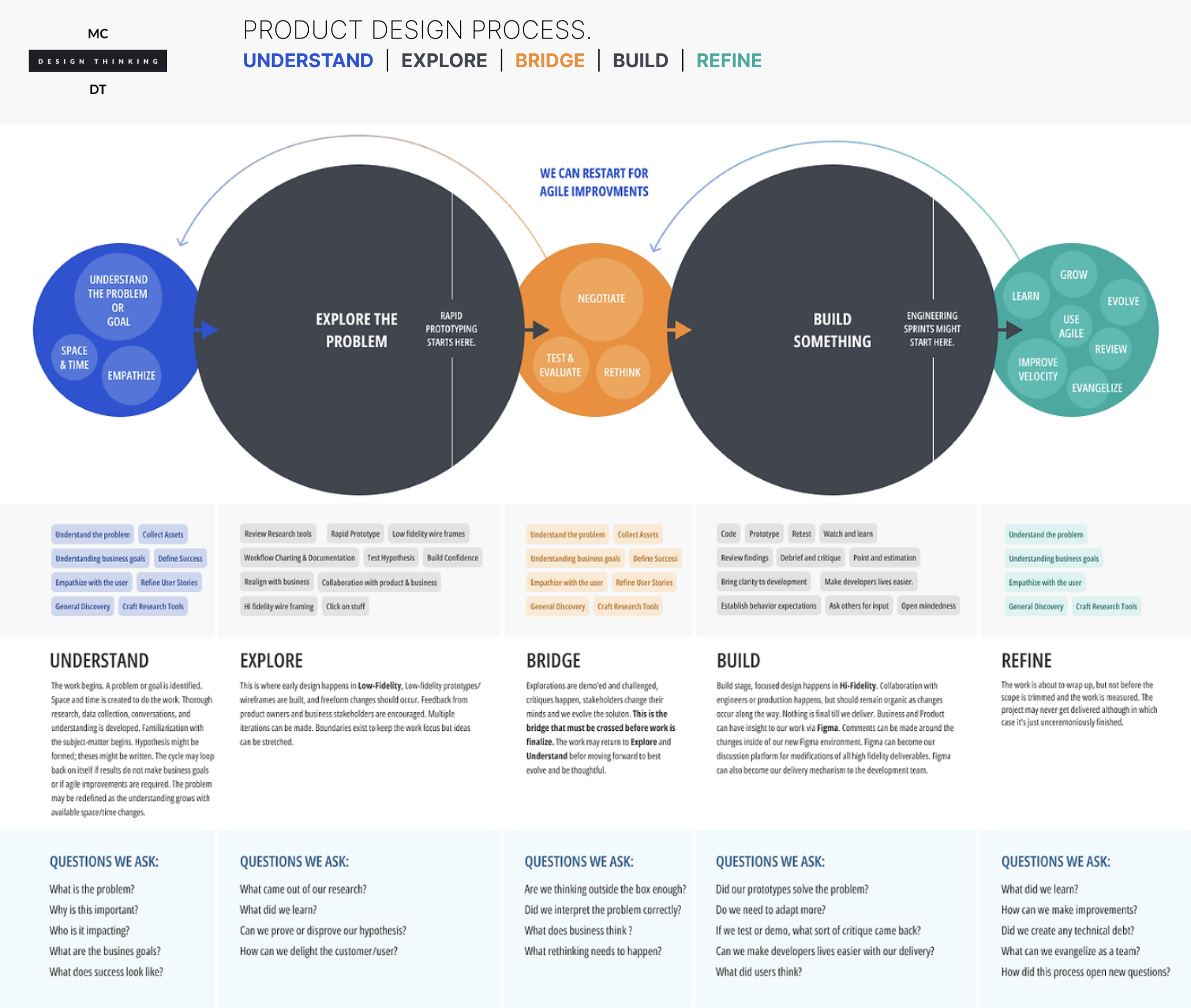
In an effort to establish a high degree of coverage across the new platform and its many stakeholders. The process addressed both Design and Research, which was new for the company, and offered a bridge to building software in a traditional sense.
Laboratory sample accessioning journey map

In an effort to uncover laboratory employee persona happiness and efficiency within a multitude of different workflows, a detailed investigation involving interviews and timing analysis of workflows uncovered interesting results for the UX team.
Key Improvements
Our research revealed several areas for enhancement, resulting in targeted solutions:
Cognitive Load Reduction: Simplified interfaces without removing essential data fields, enabling users to focus on key tasks.
Comprehensive Data Visualization Dashboarding: Developed dashboards to provide leadership and operational teams with real-time insights into all aspects of order-based operations, ensuring alignment from high-level metrics to downstream workflows.
Streamlined Specimen Workflows: Introduced consistent terminology, a unified flagging system, and centralized data updates to improve efficiency.
Unified Flagging System with Custom Views: Designed a comprehensive flagging solution with an information architecture (IA) map to categorize issue types across the order management ecosystem, providing operations teams with tailored views and streamlined resolution workflows.
Enhanced Navigation: Leveraged IBM’s Carbon Design System to create intuitive pathways, improving user interaction and productivity.
Patient-Centric Architecture: Redesigned workflows to prioritize patient data clarity, reduce duplicate records, and simplify clinician access to information.
Integrated Dashboard Analytics: Provided real-time insights into order statuses, issues, and metrics for improved decision-making and leadership oversight.
Scalable Enterprise Design System: Conducted a comprehensive audit and selected IBM’s Carbon Design System for its scalability, consistency, and pattern-sharing capabilities, reducing design time and boosting developer efficiency.


Impact
Through iterative design and consistent collaboration with SMEs, the UX team delivered a modernized system that improved user trust, reduced inefficiencies, and streamlined daily operations. Leadership trust was rebuilt through transparent communication and regular feedback sessions. The adoption of Carbon Design System set a foundation for future scalability, enhancing both user experience and development efficiency across Adaptive’s ecosystem.
Deeper Dive into the UX work at Adaptive.